
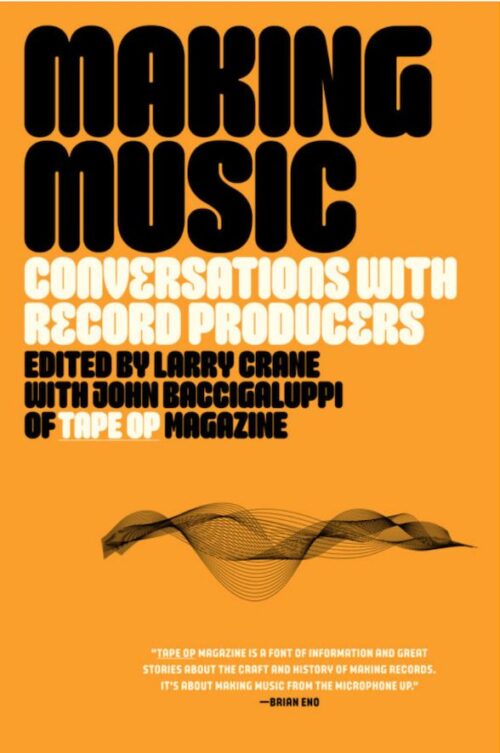
Making Music: Conversations with Record Producers John Baccigaluppi and Larry Crane
My first encounter with the Tape Op universe happened when I picked up a magazine that was laying around Mike Pack’s studio, Revolution Sounds, in Chattanooga TN. This was twenty-plus years ago. Listening to Landlord track “More Trouble” on Beneath the Wheel, and being frustrated that they didn’t do the ending phrase twice. I was stuck flipping through the pages of Tape Op. In those pages, I quickly came to see my core belief, that:
Music is a foundational tenet of human expression, and that gate-keeping, gear fetishism, and egoism—used as a way to exclude others from the necessary expression of their existence, and the resultant suppression, by these means, of the full and radiant blossoming of that existence will all eventually be viewed by any modern society in the same primitive, idiotic, and old fashioned light as which we now see racism.
is not universally shared.
So, sitting on a tweed couch in a hot-as-hell DIY studio back then, it was with significant trepidation that I looked past the slick, full color ads hawking the gear that will make you famous. I looked to the interviews with the bands, the engineers, producers, and other peripheral people in the music industry. That was a good choice. The interviews in Tape Op magazine are generally stellar. They rarely fixate on gear, but instead really dig into the creative process and philosophy that people bring to the craft of capturing recorded audio.
Making Music is a collection of interviews from Tape Op that focuses on the role of the producer, and for anyone even slightly curious about the history of the hits, it’s well worth the read. The LEE SCRATCH PERRY interview is some of the most enlightened…deranged…I can’t tell…thinking that I’ve read in a good long while. And hearing LINDA PERRY (no relation, ya dweeb) recount a songwriting session with DOLLY PARTON (R.I.P.) where DOLLY’s assessment that she was “weird, but I like you” felt right.
And while there are a few interviews with modern-ish producers, most of the content focuses on the anachronistic producer. The canonical quirky person who can play everything, compose, engineer, mix, inspire, but most of all knows when to get out of the way. I didn’t know many of the names in this book, excepting some of the inescapables (RZA, Glyn Johns, Brian Eno). But I certainly knew the songs they helped to birth and the artists who birthed them.
You’ll read stories about the REPLACEMENTS, PRINCE, BOWIE, WU TANG, all of the Def Jam crew. This book contains anecdotes and reflections on the playlist of American and British commercial music over the last 50–60 years. It’s pretty darned interesting. But, it is also a tacit embrace of the music industry and all of its flaws. There’s just so much fucking money in it that the corrupting influence of commercial interests unavoidably trickles through many of the interviews. That isn’t to say that the producers highlighted in this book were just looking for the next cookie-cutter hit. In general, the interviews tell a wholly different story. They focus on musically obsessive people who dig in so deep that they are able to form exceptionally well-informed opinions on the choices they make as they work. These interviews reflect intellectually curious, technically astute philosophers of music.
If you’re interested at all, the interview with Susan Rogers alone was reason enough to create this book. She was PRINCE’s engineer and producer from 1983 to 1988, so yeah. Purple Rain, Around the World in a Day, Parade, Sign o’ the Times, and The Black Album. PRINCE probably would’ve been PRINCE without her, but I don’t think as much of it would have been captured. She worked 25 hours a day to unleash that beautiful man upon the world, and tells us about it in Making Music.